


By Daniel Cole · Updated August 23, 2026 · Fact-checked
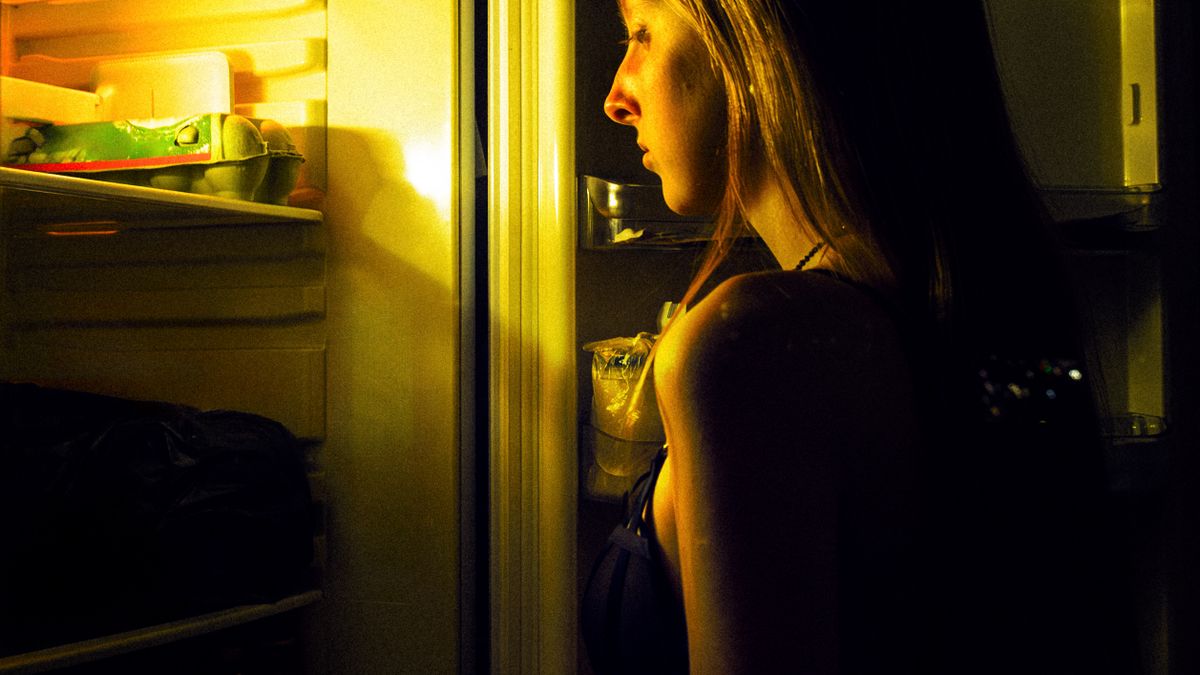
The fridge light at 11 p.m. has a particular kind of pull. You weren’t especially hungry at dinner, the plates got cleared, and then two hours later something shifts and the kitchen becomes the most interesting room in the house. If that sounds familiar, you’re in very ordinary company. Late-night eating is one of the most common things people bring up when they talk about weight, and it is almost never a discipline problem.
It’s more useful to treat the evening binge as a symptom. Something earlier in the day — or in your sleep, or in your routine — set it up. Once you find that something, the cravings get a lot quieter without any white-knuckling.
Your appetite runs on a clock, and it runs late
Hunger isn’t distributed evenly across the day. Ghrelin, the hormone that tells your brain to go find food, tends to climb through the evening in most people. Leptin, which signals fullness, follows its own daily rhythm. The practical effect is that the same amount of food feels less satisfying at 10 p.m. than it does at noon.
Researchers who study circadian rhythms have also noticed something less convenient: the foods people reach for late tend to be denser, sweeter and saltier than what they’d choose in daylight. Nobody raids the fridge at midnight for a bowl of lentils. That preference shift is real and it’s biological, which is worth remembering the next time you’re tempted to call yourself weak.
Most night eating starts at breakfast
Here’s the pattern I see over and over. Coffee for breakfast. A rushed, small lunch. Nothing between 1 p.m. and 7 p.m. Then dinner, then a second dinner in front of the TV.
Skipping or shrinking daytime meals doesn’t remove those calories from the day — it just moves them to a window where you have the least control over them. Under-eating early creates a debt that gets collected with interest after dark. If you’ve ever been shocked at how much you ate at 10 p.m. after a “good” day, that’s the mechanism.
Protein and fiber matter here more than total calories. A lunch built around a real protein source and some vegetables keeps you steady for hours. A lunch built around a pastry and a latte does not, no matter how similar the calorie count looks on paper. Our guide to what constant hunger is trying to tell you goes deeper into which meal patterns tend to backfire.

Stress doesn’t disappear at bedtime — it changes shape
Evening is when the day’s noise finally stops, and for a lot of people that quiet is uncomfortable. Eating is a fast, legal, socially acceptable way to change how you feel. It works, briefly, which is exactly why it repeats.
This kind of eating has a distinct signature. It comes on suddenly rather than building. It’s specific — you want that particular thing, not food in general. And it usually keeps going past the point of comfort. Physical hunger doesn’t behave that way; it builds slowly, it accepts substitutes and it stops when you’re full.
Naming which one you’re dealing with, in the moment, takes about five seconds and changes what you do next.
Short sleep turns the volume up
Cut your sleep to five or six hours and your appetite regulation takes a measurable hit. People who are short on sleep report more hunger, choose more high-calorie foods, and eat more in the evening — and they’re usually staying up later, which gives them more waking hours to eat in. It compounds.
The National Heart, Lung, and Blood Institute lists appetite changes among the well-documented effects of chronic sleep loss. If you’re fighting night cravings on six hours of sleep, fixing the sleep will do more than any amount of willpower training.
The couch is a cue
A lot of late eating isn’t hunger or emotion. It’s a habit loop that got trained in months ago: sit down, turn on the show, open the bag. Your brain learned the sequence and now runs it automatically. You’ll notice the bag is empty before you notice you started.
Habit-driven eating is actually the easiest of the three to fix, because you don’t have to change how you feel — only what’s within arm’s reach. Move the snack out of the cabinet you pass most often. Eat at the table rather than the sofa. Put the show on without the food and see how long the urge actually lasts. Usually less time than you’d guess.

What actually helps
None of these are dramatic. That’s rather the point — the dramatic interventions are the ones people abandon by Thursday.
- Eat enough before 6 p.m. Front-load protein at breakfast and lunch. Most people who stop night eating did it by fixing the first half of the day, not by policing the second half.
- Make dinner bulkier, not bigger. Volume from vegetables, beans and broth-based dishes keeps you full on fewer calories. Our piece on eating for fullness covers the approach.
- Close the kitchen deliberately. Wipe the counters, turn off the light, brush your teeth. A small ritual marks the end of eating far better than a vague intention.
- Give the urge ten minutes. Cravings are waves, not walls. Drink something warm and check back. Plenty of them fade on their own.
- Plan a real evening snack. Banning it entirely tends to backfire. Yogurt with fruit, a small bowl of cereal, a piece of toast with peanut butter — decided in advance, portioned onto a plate.
- Protect your bedtime. Going to bed thirty minutes earlier removes thirty minutes of eating opportunity and improves the hormones behind the craving.
When it’s worth talking to someone
Occasional late snacking is unremarkable. A few patterns do deserve professional attention: eating a large share of your daily food after dinner most nights, waking up during the night to eat, feeling genuinely unable to stop once you’ve started, or eating to the point of distress and then feeling ashamed about it.
Those can point to night eating syndrome or binge eating disorder, both of which respond well to treatment and neither of which is a character flaw. A doctor or a registered dietitian is the right starting point. Certain medications and untreated sleep apnea can also drive night eating, which is another reason not to try to solve it alone.
Frequently asked questions
Does eating late at night cause weight gain?
Total intake over time still drives weight more than the clock does. That said, late eating tends to come with larger portions, less-filling food and less awareness, so in practice people who eat a lot at night often end up eating more overall. The timing isn’t magic; the behaviour around it matters.
Is it bad to go to bed hungry?
Mild hunger at bedtime is fine and won’t hurt you. Real, gnawing hunger is a different story — it can make it harder to fall asleep and usually means you under-ate during the day. Have a modest snack and then look at whether your meals need adjusting.
How long does it take to break the habit?
Most people notice a real difference within two to three weeks once the daytime meals improve and the environment changes. The first few nights are the hardest. Expect some backsliding on stressful days — that’s normal and not a reason to scrap the whole thing.
The takeaway
Late-night eating is downstream of something else: an under-fed day, a short night’s sleep, an unprocessed stressful afternoon, or a habit loop that runs on autopilot. Work out which one is yours and the evening gets much easier to manage. Trying to out-discipline it at 11 p.m., when your hormones and your habits are both working against you, is the hardest possible place to fight that battle — and the least necessary one.
This article is for general information only and is not medical advice. Talk with a qualified healthcare professional about your individual circumstances, especially before making significant changes to your diet.